After an €30,000 order of office furniture for our own office went wrong, I started thinking very differently about the added value of a configurator. Because the furniture was made to order, we visited the supplier to select the colours and materials for the different products together. We used the samples available there, allowing us to see and compare different combinations directly.
Later, we received the order confirmation, where all our choices had been translated into a list of codes. That translation is where things went wrong. Some of the codes were mixed up, and because we didn’t have the samples ourselves, we had no way to recreate or verify the colour combinations. In the end, the products arrived in the wrong colour combinations — something that could no longer be reversed.
This happened to us personally, but we regularly hear similar stories from companies we work with. It’s not an isolated problem. The fact that this time it involved our own furniture made me look at configurators differently. A configurator isn’t just a pretty picture. It’s also a communication tool.
Orders are handled by people — and people make mistakes
Many ordering processes involve far more than the moment a customer places an order. An order passes through different departments and is handled by multiple people. Not only during the ordering process itself, but also in production, work preparation and assembly, there are moments when information needs to be transferred, checked and passed on. The more steps and people involved, the greater the chance that something goes wrong along the way.
It doesn’t have to be a major mistake. In fact, small errors are often the most dangerous because they can easily travel through multiple stages without anyone noticing. A code entered incorrectly, a selection that appears differently on an order confirmation, or a detail that is no longer visually checked can become a much bigger problem later in the process.
That is exactly why this goes beyond customer experience. A configurator not only helps customers make choices, but also records those choices in a way that remains clear throughout the entire process. Not as an abstract code, but as a visible end result.
Why visuals are stronger than a list of codes in practice
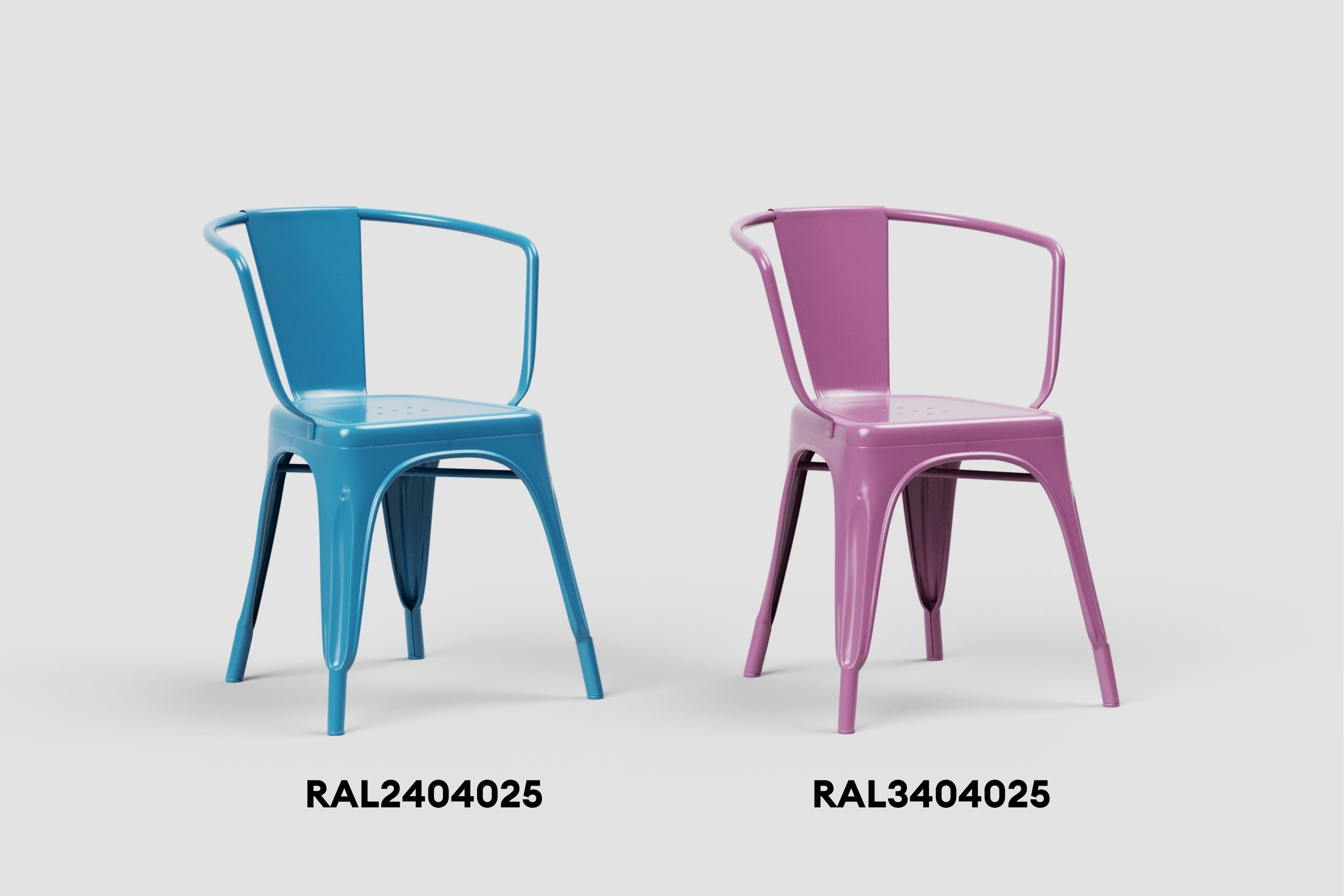
With physical products, a lot comes down to nuance. A different fabric, a slightly different wood colour or a subtle change in finish can significantly affect the final result. Yet in many processes, these choices are still reduced to lists, colour codes and individual descriptions, while in practice people respond much more strongly to visuals than to a series of numbers or names.
You can see this in how easily codes can be confused. The difference between RAL3404025 and RAL2404025 is just one digit, which is easy to overlook. An image showing a blue chair instead of a purple one stands out immediately.
Not everyone uses the same terminology for product components either. Especially when working internationally, or when customers and suppliers each use their own terminology, misunderstandings can easily arise. What one person calls the shell, another might call the seat. A visual representation removes many of these language barriers because you are not only describing what has been selected, but also showing exactly what is meant.
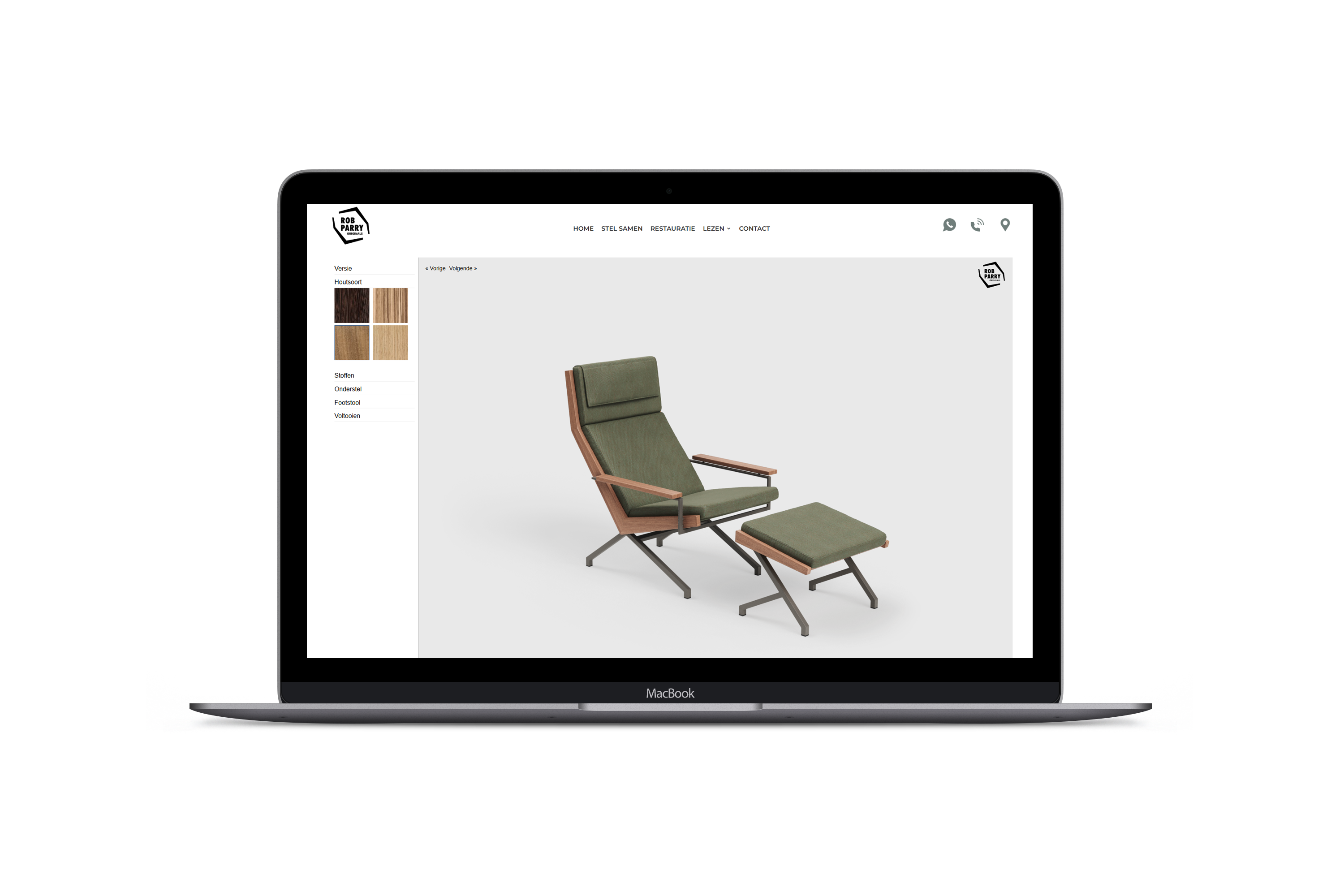
A configurator removes much of this abstraction. Instead of only recording which codes have been selected, it also shows what those choices actually mean for the product. This makes internal checking, coordination and handovers much clearer.
A configurator doesn’t just help the customer
Online, a configurator is often presented as something that mainly improves conversion, ease of use or the overall customer experience. Those are clear benefits, but they don’t tell the whole story.
For companies selling physical products, an important part of the value lies in what happens internally. A configurator can help record decisions more clearly, make handovers more reliable and reduce uncertainty later in the process. This makes it not only a sales tool, but also a way to reduce costly mistakes and unnecessary rework.
This is particularly relevant for brands with many product variants, multiple material options or products available in different configurations. In these processes, it doesn’t take a major system failure to cause problems. A single incorrect entry or unclear handover can be enough to cost money, create additional work and damage confidence in the process.
And that is exactly why it is too limiting to see a configurator as simply a nice extra on a website. Once a configurator helps visually confirm choices, it also becomes valuable for sales teams, back-office staff, dealers, project furnishers and everyone else involved with the order later in the process.
When does a configurator become worthwhile?
The investment in a configurator naturally depends on the complexity of the product and the number of available options. But the most interesting question is often not how many variants a product has. The more important question is how much risk enters the process once choices need to be communicated.
If you regularly have to explain which combination is intended, if customers struggle to get a clear overview of the available options, or if multiple people internally work with the same order, visual confirmation quickly becomes valuable. Even with relatively simple products, this can make a significant difference.
So you don’t need to sell an extremely technical or modular product before a configurator becomes relevant. It becomes worthwhile as soon as visuals help prevent mistakes, make choices easier to verify and simplify communication.
Concusion
A product configurator is usually approached from the customer’s perspective. Understandably so, as it is a visible way to make choices easier and present products more attractively. But in practice, a large part of its value is often internal.
Orders are handled by people, and that is where things sometimes go wrong. Not because of carelessness, but because lists of codes become difficult to interpret, terminology gets mixed up and visual choices are later reduced to abstract information. A small mistake can then lead to more than just an incorrect delivery: it can cost money, create additional work and damage trust in your company.
A configurator helps prevent this. Not only by showing the available options, but by making choices visible and easy to verify for everyone involved. And that is exactly why a configurator isn’t just for your customer — it’s for your own business too.